
Stop CARRYING THE ENTIRE RELATIONSHIP ALONE REBUILD A MARRIAGE THAT FEELS CONNECTED
Couples Therapy
with Mishelle Dyer, MS, LPC Oklahoma
You can rebuild trust, find your voice, and feel like a team again -- even when one person is still working through their part. This is a structured 90-day path for faith-centered couples who are exhausted, disconnected, and ready for something to actually change.


Stop Losing Yourself Trying to Fix a Marriage That Feels Like It's Already Broken
Couples Therapy
with Mishelle Dyer, MS, LPC Oklahoma
In 90 days, stop losing your voice in arguments, feel like your needs actually matter, and start functioning like a real team -- without the same conversations going in circles and nothing ever changing.
HOW IT WORKS
This is the Connected Covenant Framework. A 9-step roadmap that helps you understand what keeps going wrong, change how you both show up, and rebuild the trust and connection your marriage was supposed to have -- without pretending things are fine or losing yourself in the process.
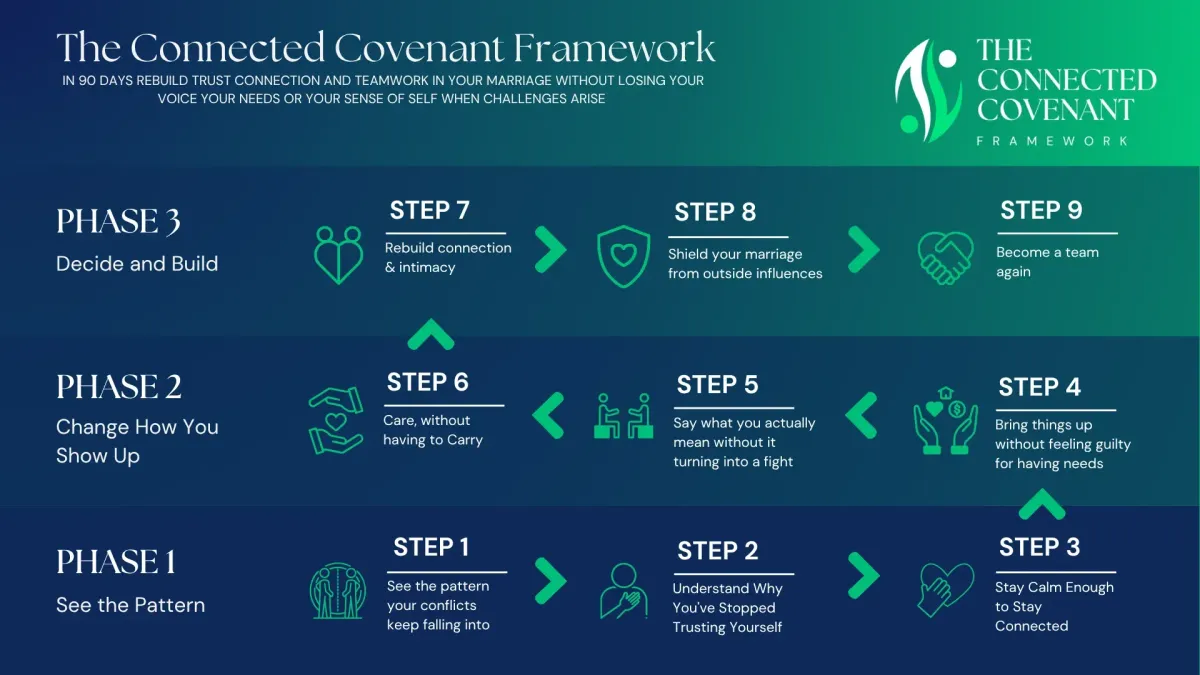
Phases of the Program
Phase 1: See the Pattern
Before anything can change, you have to understand what keeps happening and why. In this phase you get clarity on the cycles you keep falling into, why your instincts have stopped feeling reliable, and how to stay calm enough to stay connected when things get hard.
Step 1: See the Pattern Your Conflicts Keep Falling Into
Recognize the loop that turns a small frustration into a full shutdown or blowup
Understand why the same argument keeps happening even after you've talked about it multiple times
Identify whether you're dealing with a solvable problem or something that goes deeper
Stop feeling crazy for noticing what you're noticing


Step 2: Understand Why You've Stopped Trusting Yourself
Name the moments where you second-guessed your own instincts and stayed quiet
Get clear on whether what you're feeling is a signal worth paying attention to
Stop absorbing the label of overreacting or being too much when something is genuinely off
Reconnect with your own judgment so you can act from clarity instead of anxiety
Step 3: Stay Calm Enough to Stay Connected
Learn to regulate yourself in the middle of a hard conversation without shutting down or blowing up
Stop letting escalation end every attempt at a real discussion
Build the capacity to stay present with your partner even when it's uncomfortable
Practice tools in sessions that work outside of sessions

Phase 2: Change How You Show Up
Once you can see what's been happening, the work shifts to how you communicate it. This phase is about learning to bring things up without guilt, say what you actually mean without it turning into a fight, and stop carrying more than your share.
Step 4: Bring Things Up Without Feeling Guilty for Having Needs
Stop swallowing what matters to you just to keep the peace
Learn how to raise something important without it immediately getting turned around on you
Communicate what you need even when it feels inconvenient or risky
Feel less alone in a marriage where your voice keeps getting lost


Step 5: Say What You Actually Mean Without It Turning Into a Fight
Find the words for what you're really trying to say instead of watching it spiral
Stop conversations from ending in defensiveness, doors slamming, or silence
Learn how to stay honest and still stay connected in the same conversation
Practice talking about hard things in a way that actually leads somewhere
Step 6: Care Without Having to Carry
Recognize where you've been absorbing everything because asking for help costs too much
Set limits on what you can sustain without collapsing into resentment
Stop over-functioning as a way to manage your partner's discomfort
Learn the difference between showing up for your marriage and disappearing inside it

Phase 3: Decide and Build
After you can see the patterns and change how you communicate, you rebuild. This phase is about restoring connection and intimacy, protecting your marriage from the things that keep pulling it apart, and learning how to function as a real team -- one that makes decisions together and has each other's backs.
Step 7: Rebuild Connection and Intimacy
Rebuild emotional and physical closeness that hasn't felt natural in a long time
Stop going through the motions and start reaching each other again
Address the distance that built up slowly without either of you fully realizing it
Create the kind of connection that makes your marriage feel worth protecting


Step 8: Shield Your Marriage from Outside Influences
Set clear limits around extended family, outside relationships, and competing loyalties
Stop feeling like you're always the last priority in your own marriage
Get on the same page about who your marriage is accountable to
Protect the covenant you made from the things that quietly erode it
Step 9: Become a Team Again
Make decisions together instead of one person leading and one person resisting
Feel like your husband or wife actually has your back -- in public and in private
Build a shared vision for the marriage and family you want to create
Stop functioning like two individuals under the same roof and start feeling like partners

Stop Surviving Your Marriage. Start Building the One You Actually Want.
You don't have to keep having the same conversation with nothing changing. You don't have to keep wondering if you're the problem or keep absorbing all of it alone. The Connected Covenant Framework gives you a clear, structured path to understand what's been happening, change how you both communicate, and rebuild the trust and teamwork that makes a marriage feel worth it. Not a quick fix. Not more of the same. A real way forward -- in 90 days.
WHAT WE'RE GOING TO COVER
Most couples who come to me aren't in crisis. They're just exhausted. The arguments aren't new. The distance isn't dramatic. It's the slow accumulation of feeling unheard, unsupported, and unsure whether anything is ever going to change. If any of that sounds familiar, this is what the work actually looks like.

When Conflict Keeps Going in Circles
How to stay in a hard conversation when it turns into him telling you you're overreacting or calling you crazy when you know what you felt was real
How to bring up the fact that this has been a sore point for months and it results in a change for about a week before everything fizzles back to where it was
How to stop the cycle where every argument ends with someone shutting down, storming off, or going silent for days
When You're Doing Too Much and Getting Too Little Back
How to handle feeling like there is no real partnership when you work full time and come home to handle most of the childcare, household management, planning, and logistics while the other one's contribution is limited to bills and taking out the trash
How to keep going when you're burned out and nearly mentally checked out and you don't know how to fix this or if it even can be fixed
How to stop feeling like you're the only one who gets the trash version of her while strangers get the gold
How to address feeling like you adopted a child not a spouse when there is no support there at any time and she promises to change and insists she's trying but nothing actually changes


When Faith, Family, and Outside Pressures Are Getting Sucked into the Problem
How to handle a husband who comes back wanting a divorce every time he visits his family and has done it about six times since you've been married
How to cope when you asked your husband if you can pray together and he refused you twice and it breaks your heart more each time
How to keep going when you attend church by yourself and have for almost 18 years and you believe in the sanctity of marriage but you're having doubts about yours
How to figure out what to do when you understand that being married is not enough on its own and both parties have to want it to continue -- but the relationship no longer feels emotionally fulfilling

Meet Mishelle Dyer, MS, LPC
I became a therapist because I know what it feels like to be inside a relationship where you're trying everything and nothing seems to land. I've sat with couples who love each other but can't seem to stop hurting each other, or just can't get on the same page. I've worked with partners who came in as roommates and left as teammates. And I've walked alongside individuals who needed to find their own voice before they could show up fully for their marriage.
My approach is grounded in Gottman research and shaped by a deep respect for faith and what it means to build something that actually lasts. I work with faith-based couples across Oklahoma who are ready to stop surviving their marriage and start building the one they always meant to have.
FAQS
How does this program work?
This program follows the Connected Covenant Framework and typically unfolds over weekly video sessions across 90 days. Everything takes place virtually so you can work from home, in a space that's private and comfortable. Sessions start with a clear picture of what's been happening in your marriage, then move step by step through understanding conflict patterns, changing how you communicate, and rebuilding connection and trust. Each session is focused and practical -- what you work on in session is designed to translate into how you actually show up at home."
What's covered in the program?
The program covers the three things that most often break down in long-term marriages: the conflict cycles that keep repeating, the communication patterns that leave both partners feeling unheard, and the trust and intimacy that slowly erode over time. You'll learn how to bring up hard things without it turning into a fight, how to set real limits without guilt, how to stop absorbing everything alone, and how to rebuild the kind of partnership where both of you feel like you matter and you have each other's backs."
Who is this for, and not for?
This program is built for couples who are exhausted and disconnected but still willing to try -- especially those navigating faith, covenant, extended family pressure, or the slow drift that comes with kids, responsibilities, and years of unresolved tension. It works best when both partners are willing to look at their own patterns and engage honestly in the work. It is not the right fit for couples in active crisis situations involving safety, or for someone looking for a quick fix without doing the personal work alongside their partner.
What if only one of us wants to come?
It happens more than you think. If your partner is hesitant, the first step is a consultation where we talk through what's been happening and what the process looks like. Sometimes one partner starts, gains some tools, and the other follows. Sometimes just having a clearer picture of what therapy actually involves -- not venting sessions, not blame assignments, but real structured work -- is enough to get both people in the room.
What if I'm still not sure?
That's completely normal. Most people who reach out are not sure -- they're tired, they've tried other things, and they don't want to invest in something that won't work. The first step is a no-pressure consultation where you can ask questions, talk about what's been happening, and decide whether this approach feels like the right fit. There's no obligation."
Your marriage isn't beyond repair. But it does need something different than what you've been doing.
This work is not about deciding who's right or fixing everything in a single session. It's about giving you both a clear path to understand what's been happening, change how you show up for each other, and rebuild the trust and connection your marriage was built on -- without losing yourself in the process.

COPYRIGHT © 2026. ALL RIGHTS RESERVED.